

Austin’s had its heart cut out more than once. It’s gained its confidence back and carried on. And throughout its history, it has grown. People who stay the longest come to wish it would never change, even when it always has, and inevitably will continue changing. Less than a lifetime ago, it was just one of those capital cities with government jobs and a university, and not much else going on. Armadillos would roam the downtown streets.
It’s not like that anymore. Anyone looking to make it here, needs a job. And yet, people from all over Texas will come here to seek their fortunes, and so will those from places further afield. They do this for any number of reasons, but video game development is surely one. I’m not convinced everyone who is here knows the truth of that, and how it’s shared between so many who have looked at a map of North America and decided Austin was the best place to plant a flag, regardless of how many already had.
What kept happening was a rhythm of boom and bust, rise and fall, about every 4 or 5 years. It wasn’t a perfect rhythm, and sometimes it broke but was never greatly interrupted, even when it seemed like the music died. Projects would end, studios would close, but others would be waiting in the wings to employ whoever was still around. There was grumbling, but those who wanted to stay in Austin usually found a way to get another job.
In 2012 I worked with Austin PBS to produce a live discussion show at Studio 6A, where they used to shoot Austin City Limits, It was called (Not) The End Of The World, playing off the idea of the misunderstood end of the Mayan calendar. I brought out leads from Dishonored, Darksiders 2, Star Wars: The Old Republic and Halo 4. The idea was to reassure everyone that despite setbacks, there would still be a world to live in, going forward, and Austin would be part of it.
We were already staring at blast craters. That summer, the IGDA chapter had planned but did not execute a summer picnic at Richard Garriott’s property on Lake Austin, which in previous years had attracted nearly 800 attendees. GDC Online, the last remnant of what had been the Austin Game Development Conference, had its final event that October, with its owners in California favoring an event in Los Angeles called GDC Next, which would run two years until it would also be forgotten entirely.
As insult to injury, in January 2013, the same month, THQ went bankrupt, shuttering Vigil Studios in Austin, and Disney shut down Junction Point Studios, who had just released Epic Mickey 2: The Power of Two three months earlier. (I had reached out to Junction Point for their participation in the PBS show, but they had declined.) Between the two, some 150 developers were out of work just as the new year began.

The world had not ended. But many things would not come back. What had been got replaced with new approaches that turned out to be a lot like what had been.
I say all that not to suggest that making games is a joyless slog. I’m suggesting that it’s easy to assume change is temporary, even if it’s recognized as a constant, but that it will come around again. Another big project will get announced, and eventually hundreds of developers will be hired. Something else will ship, probably with a “live-service” component and multiplayer we used to call “massive,” requiring yet another login and password. Or maybe, as has happened multiple times since the COVID-19 pandemic began, the project will turn out to only have funding enough for a demo, and another funding source will be required to take the project over the finish line. And maybe it won’t be found, and everyone paid to work, will have their work burned in front of them.
Maybe it’s time to slow that down. Maybe the race to bring more products to market assumes too much about the market existing. Maybe more hand-crafted, smaller-scope experiences can find an audience enough to justify the investment, in ways the really big projects don’t anymore. Maybe more concerted efforts could be made to find an audience for those kinds of games.
Maybe, just maybe, that could be what Austin becomes known for. Maybe not all at once, but maybe more than it is, and maybe more like it had long before video games were an entertainment medium. There are still people in Austin who worked at Origin and Acclaim and Maxis South and SimTex. There are still more young developers that are a little more enterprising than most devs tend to be.
We’ll need a few things.
- More rich uncles. Those that are independently wealthy and have cash flow and aren’t expecting a high return from video game production or publishing. Games might occasionally have high ROI, but not all will. (Richard Garriott, in his day, definitely counted as one, and there have been more.)
- Varied structures of management and production. Rolling up new studios with more than 50 people that have not completed projects before as a team is well and good, but how about those who can use a consolidated technology pipeline to make lots of prototypes for low-scope projects?
- More focus on promotion and marketing to new audiences. Touch-screens and Tiktok have created a generation of gamers for whom downloading and installation is too much friction. Making very many more games with photorealistic graphics and hours of story-driven gameplay in a grand rush to complete development before some other giant game ships is not so much of a workable strategy anymore. Instead of always trying to steal some other existing market, aim for building new ones. It shouldn’t be easy for me to find competent development talent available for work and next to impossible for me to find competent promotional or business development talent. Bridge that gap.
- More cooperation. I know studios often get started because talent gets tired of local management, but the more studios in Austin could acknowledge and work together for anything at all, without bothering the sensibilities of their financial partners, the most Austin will seem like a place where quality games get made. And if it’s not cooperating with development, try promotion cooperatives. (Like the original Gathering of Developers, but with the technology they didn’t have 25 years ago.)
- Another local game-industry conference or summit, tailored to start small and grow on its own, with few moving parts. This might be the one closest at hand, but even if it’s most likely, won’t mean it’ll be easy to pull off. We’ve gone for long enough without one.
These are the kinds of things I’d like to see and hear more about, in Austin. As much as new studios and opportunities to employ lots of game developers are, I’m less interested in projects that aren’t going to end, that are attached to degrees of impossibility high return on investment, or tied to “demo” production rather than full production, just because the full cost of real production can’t be committed.
Three more rhetorical things.
AI. Everyone, just go watch Laura Fryer’s video essay on the subject, or Jazza’s if you have more time. I was until recently of the opinion that developers could still get away with using genAI for prototyping or placeholders, but considering what a certain well-heeled indie darling got in the past month once AI was revealed, I agree with Laura now. Until it’s possible to have useful conversations with mutual understanding about goals and applications, the heat is just too hot right now. Besides, creative processes among humans and the value of a team made up of people who not only can be productive but trust each other, have never appeared on a balance sheet. That in my mind gives a ready excuse for tech fetishists to just want to bypass creative humans entirely, and skip to the end with a product assembled by the latest water-guzzling, RAM-eating utility monster. Never mind that the product would then need to be sold to humans, because AI ain’t got no disposable income.
Education. I have many good friends in higher-ed, and I’ve come to appreciate more every day, that game development as a study topic is a demand-driven racket producing far more graduates than there ever will be jobs available. This isn’t a new problem, and those who use their real experience in the field to teach not just theory but applied knowledge, are to be commended. That said, 1) the role of academia to address opportunity, not just education, will always be fiddly, and 2) the most special part of getting to study video game development in Austin is not to be found in the classroom, but rather being in geographic proximity to the people and history that represent local industry. Some instructors are good about encouraging their charges to go seek meaningful professional connections with those who should be considered peers (we call it “networking” but it’s a lot more about just presenting yourself as a capable, not-malignantly-crazy human being) and some are courteous about not sending unwashed first-year students to make asses of themselves. Others could still do better to acknowledge what exists off campus, that programs all over Texas not close to Dallas or Austin, would love to have.
Word choice. Everyone who’s still using the term “passion” to describe what would-be professional creatives need to succeed, just stop. Use words like “drive,” “resilience,” “toughness,” or anything else that doesn’t involve misunderstandings about emotional range and responses to stimuli. Having less control over one’s affectations does not make one more equipped for a life in creative pursuits. It is instead a description of what happens when one fails to get out of one’s own way.
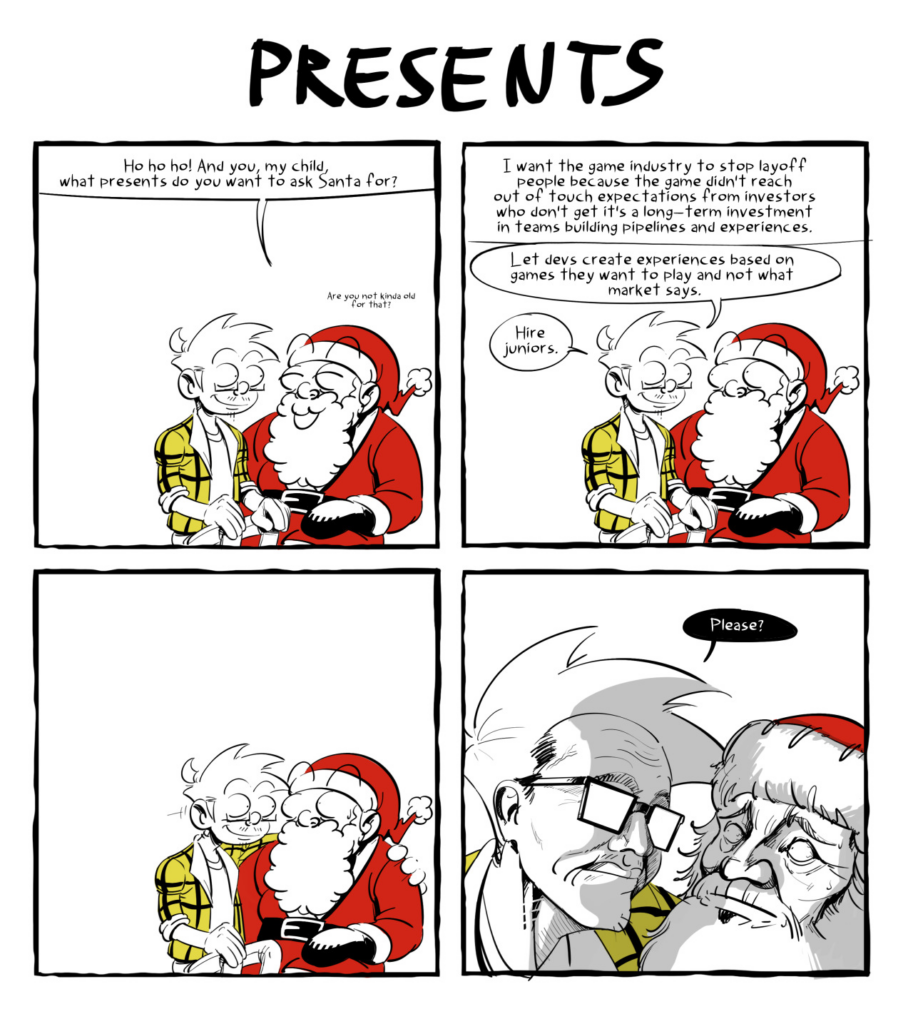
Happy new year, folks. Henderson out.
1/2026
Christopher Hodges
January 15, 2026 at 11:01 amThis. Is. Golden!
– djentdragon
Walt Corona
June 17, 2026 at 11:03 pmI enjoyed reading this.