

I really don’t want this to sound like an old man shaking his fist at the clouds and saying “You kids today don’t understand how good you have it,” so please excuse me if any of this does sound that way. What I want to do is describe just how far ahead these people were thinking and how the world today has been catching up to them.
Yes, Origin Systems made the Ultima series and the Wing Commander series, but they made a heck of a lot more games, too, and they tried to make a heck of a lot more. (The “killed” games just break me).
The staff at Origin was constantly pushing the limits of everything, which ultimately pushed the limits of what a computer owner would be able to afford. It was kind of like, “Let’s keep putting stuff in the game until it won’t be able to run anymore and then we’ll just tell people they have to upgrade their entire system.” It wasn’t meant to be that way, but that’s how it was. And it worked!
Hardware manufacturers would send us boxes and boxes of their hardware and if a programmer got a wild hair, sometimes you’d show up on Monday and support for that device would be in your game.
Let me give you a look at some of the things that were first—or at least way ahead of the curve—at Origin.

The engine reuse philosophy was one of the biggest. Most companies in the early ’90s built a new engine from scratch for every major project because “this one needs to be better.” Origin took the opposite approach: once they had a solid engine, they milked it for everything it was worth. Now we have engines like Unity 3D and Unreal. (Don’t get me started about having mouse drivers and audio drivers that work!)
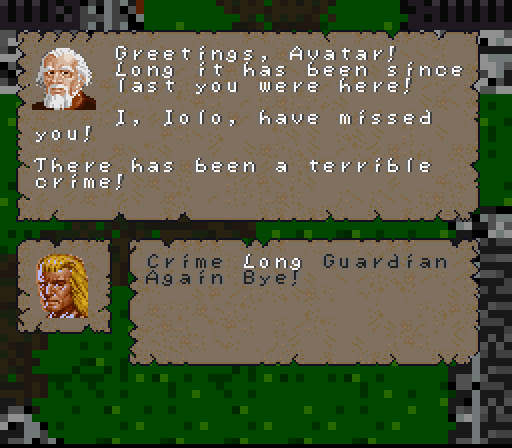
The Ultima VII engine (1992) is the poster child. It powered the full PC version of Ultima VII: The Black Gate, then immediately got reused (with lots of loving tweaks) for Ultima VII Part Two: Serpent Isle (1993) and its Silver Seed expansion. And the same core tech got heavily modified and ported down to the Super Nintendo for the console versions I worked on: Ultima: The Black Gate (SNES, 1994) and Worlds of Ultima: The Savage Empire (released in Japan as Ultima: Kyōryū Teikoku, 1995).
We used multiple stripped-down, SNES-optimized versions of the U7 editor to build the exteriors, dungeons, building interiors, and all the scripting logic. I make the point that there were multiple versions because my version got corrupted and I had to complete my work on the game by editing in hex. The same engine DNA even lived on in Crusader: No Remorse (1995), where the isometric viewpoint, object physics basics, and interaction systems got repurposed into a top-down action shooter.
That reuse wasn’t laziness; it was smart. Making a game back then was time-consuming and expensive. We had to deal with a typical PC being a random piece of crap with no video card, probably no sound card and until the mid-90s, way too many operating systems. But the games needed them so we had to deal with it.
It meant new hires like me could walk in, sit down at a workstation, and start building actual game content on day one. No six-month ramp-up writing rendering code or pathfinding from scratch. The tools were already there, battle-tested, and documented.
I got handed that converted Ultima editor on my first day, and the team showed me how to script events, place NPCs with daily schedules, stack objects, trigger dialogues … everything. It felt like cheating.
In most studios back then (and honestly, even now in some places), you’d spend your first year just getting the tech to the point where designers could touch it. At Origin, world building was the priority, and they knew that great tools would unleash the creative power of the team. And building worlds took a lot of people a lot of time. Better tools meant more deeper worlds faster.
That philosophy extended to the art pipeline in a way that still blows my mind. Austin had this incredible underground scene of concert-poster artists from the Armadillo World Headquarters and Vulcan Gas Company days—psychedelic, detailed, cosmic-cowboy ink work that defined Texas counterculture in the ’60s through ’80s. Origin hired some of the absolute legends: Micael Priest (the guy who basically invented the armadillo as an Austin symbol and did iconic Willie Nelson posters), Jim Franklin, Danny Garrett (known for his Stevie Ray Vaughan and blues portraits), and Steve Pietszch and so many others, enough to fill a book.
These were hand-ink, pen-and-brush masters, not computer guys. We hired sculpture artists, too. They didn’t just hire artists to do box art and manual illustrations (though they did plenty of that). They sat them down and taught them the entire digital pipeline, step by step. 2D paint programs were first, then 2D animation tools, then full 3D modeling, then 3D animation.
Origin was one of the very first studios to bring in Autodesk 3D Studio (the DOS predecessor to 3D Studio Max) and use it to create game-ready objects: pre-rendered ships, environments, props. They didn’t just buy the software; they flew in official Autodesk/Kinetix trainers for regular on-site sessions.
Constant training. The poster artists went from drawing flyers for rock shows to modeling Kilrathi fighters and Britannian castles in 3D. That cross-pollination gave Origin’s visuals a soul that pure tech artists sometimes lack.
On the hardware side, we were shameless early adopters. SoundBlaster cards showed up in boxes from Creative Labs, and if a programmer (or one of our audio-engineer-programmers, because in the early ’90s you often had to be both) got inspired over the weekend, you’d come in Monday and digitized speech or new MIDI instruments would already be working in your build. The same thing happened with 3dfx Voodoo Graphics cards when they arrived in late 1996. Wing Commander: Prophecy’s VISION engine was built native for Glide from the start. We even shipped a Voodoo-exclusive tech demo before the full game to iron out compatibility across every weird card variant people owned.
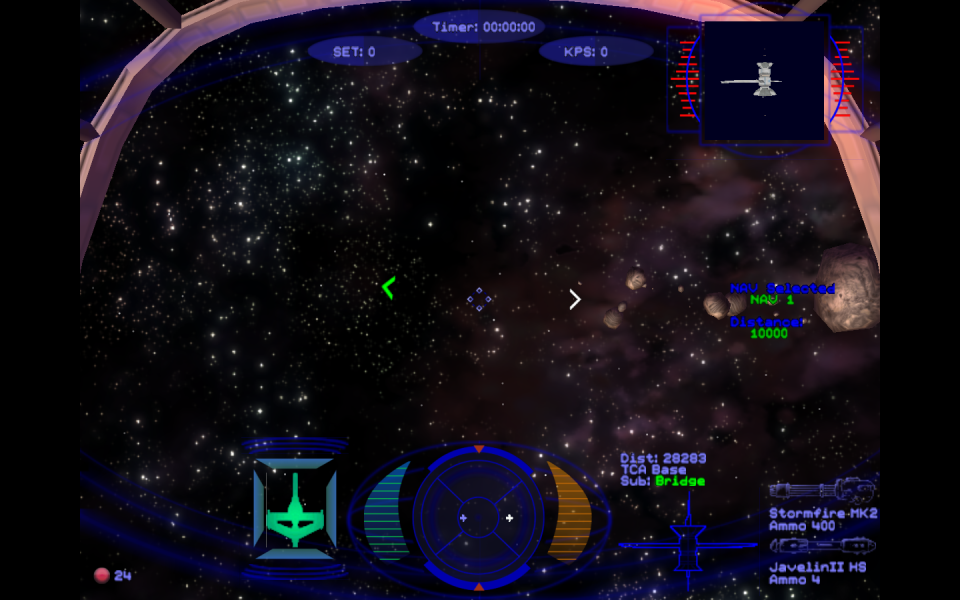
Players bought our games to show off their systems because our titles demanded the latest everything: more RAM, faster CPUs, SVGA resolutions, CD-ROM drives (Wing Commander III and IV shipped on four or five CDs each), and eventually 3D acceleration. It wasn’t predatory; it was ambition. We kept cramming in FMV, orchestral scores, particle effects, and branching stories until the game wouldn’t run on last year’s hardware—then we told people to upgrade. And they did.
We even invented our own version of DLC (or as they were once called, “expansion packs,”) before the internet could deliver it. Games would ship text-only or with placeholder voices, then the audio team would finish recording real talent—sometimes while the discs were already being pressed. A few months later, you’d get a floppy (or three) in the mail: the Wing Commander II Speech Accessory Pack, Privateer Speech Pack, Strike Commander add-ons. Install those, and suddenly your wingmen were yelling “Oh S@#$!” in digitized glory, or Mark Hamill was delivering lines he recorded after the game hit shelves. It was post-ship content delivered by snail mail. Hollywood voices too: WCIII had Mark Hamill, Malcolm McDowell, John Rhys-Davies and Tom Wilson. Real movie stars in a computer game, in 1994.
And the culture around customers was unlike anything I’ve seen since. Quality Assurance and Customer Service/Tech Support were one unified department under Kay Gilmore, and they weren’t siloed off as “bug catchers” or “phone-answerers.” They were embedded (or were supposed to be—and you could tell which projects did or didn’t) from the very beginning of every project, representing the player’s perspective in every meeting. I believe they stood by the adage, “We’ve failed every project that’s gone out the door,” because they knew the obvious and obscure bugs that were in every one.
When a project shipped, QA wrote exhaustive post-mortems: what went right, what went catastrophically wrong, what to never do again. Those documents became the studio’s bibles. Teams that wanted to avoid repeating mistakes just opened the book from the last project. CS logged every player complaint, bug report, and feature request, then evangelized for the customer inside the building.
There’s a legend (and yes, it happened more than once) that if a developer seemed oblivious to how their decisions affected players, they’d get “put on the phones” for a week or two. Nothing drives home the impact of a crash or confusing UI like hearing a frustrated customer explain it to you in real time.
Looking back from 2026, it’s wild how much of what we take for granted today: modular engines, live-service patches, community-driven content, hardware-pushing visuals, player advocacy baked into production, was being prototyped at Origin, 30 years ago.
We weren’t perfect. We crunched, we overreached, we shipped buggy messes sometimes. But the people there were dreaming so far ahead that the rest of the industry is still catching up.
And I got to be in the room for it.
Billy Joe Cain worked at Origin Systems from 1992 to 1997 and several other Austin-based game development studios in leadership positions. He now runs the Radical Empathy Education Foundation with his wife, Jacqueline. They write the blog Beyond the Red Flags together.